



This President’s Day, Rediscover The Reverent Faith That Steadied George Washington In Crisis
This President’s Day, we reflect on those faces on Mt. Rushmore — iconic leaders from our past that demand our admiration. Sometimes, if you’re like me, you find yourself wondering where such leaders are now. Where is the next George Washington — strong, faithful, humble, resolute, worthy of respect, a man worth following?
Most leadership failures are not caused by a lack of ability. They stem from a missing virtue which Americans have largely forgotten. The strength that built this nation was not loud, flashy or self-assured. It was reverent.
ReadMore

Reverence is not the same thing as meekness or humility. Humility may grow from reverence — but reverence is the root. It is deeper and wider-reaching. Reverence is the awareness that we stand before something holy, that authority is purposefully granted, and that every part of life is accountable to Heaven.
And modern Americans increasingly want the fruit of reverence without the fear of God underneath it. We carve our heroes into stone — but forget the faith that steadied their souls.
Few American leaders embodied this understanding more fully than George Washington.
Washington’s leadership can feel foreign today, not simply because of historical distance, but because the moral framework that shaped it has largely faded from public life. His greatness did not rest in physical presence, strategic brilliance or even unmatched authority. Though he helped free a nation from tyranny, his own life was marked by consistent submission to a higher authority than the British crown.
This posture was evident early. At just twenty years old, Washington penned a prayer that reveals the foundation beneath his public life:
“Give me grace to hear Thee calling on me in Thy word… that it may be wisdom, righteousness, reconciliation and peace to the saving of my soul… Bless my family, kindred, friends and country… for His sake, who lay down in the grave and arose again for us, Jesus Christ our Lord.”
This was not the language of a man intoxicated with ambition. It was the posture of a man who didn’t just know about God, but knew Him — who trusted that Providence governed human affairs and that Christ’s reign extended over every arena of life.
Washington was revered by men because he feared God more than he feared failure. That holy fear did not make him timid. It made him steady.
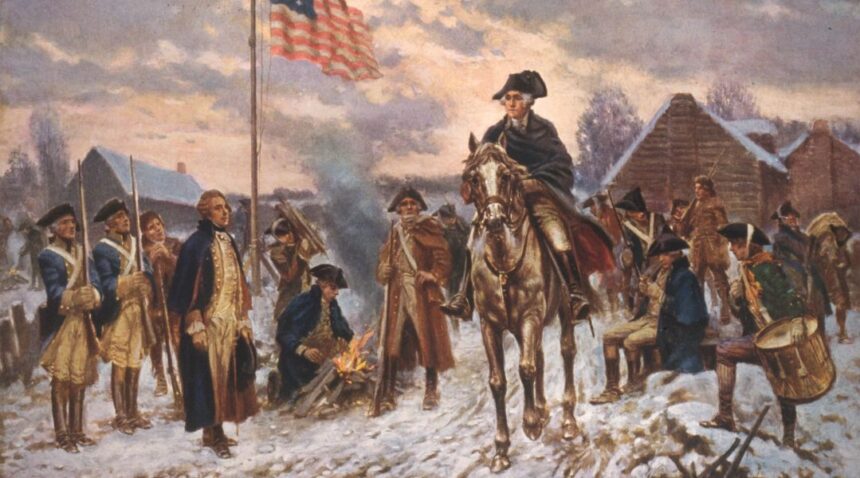
Nowhere is this clearer than at Valley Forge.
The Continental Army arrived starving, ill-clothed and demoralized. Supplies failed. Disease spread. Congress wavered. Critics questioned Washington’s competence. By every earthly measure, the cause of independence stood on the brink of collapse.
Washington did not retreat to comfort. He shared the hardship of his men — and, by all credible accounts, sought God in prayer. He understood that no amount of natural resolve could sustain a leader in such a moment.
In that winter, reverence bent the knees of the commander-in-chief. That posture — strong shoulders stooped in prayer — reveals the true source of his steadiness.
Washington’s reverence did not merely sustain him in crisis. It restrained him in victory.
When independence was secured, many expected him to seize power. History offered ample precedent. Revolutions often end with strongmen.
Washington refused.
In 1783, he resigned his military commission and returned to private life, commending the young nation to “the protection of Almighty God.” The act stunned observers on both sides of the Atlantic. Later, as President, he again relinquished power voluntarily after two terms, establishing a precedent that shaped the republic for generations.
These decisions were not merely political calculations. They were consistent with a worldview in which authority remained accountable beyond public approval or personal legacy.
We live in an age that prizes charisma over character, platform over principle and confidence over accountability. Even in many corners of American Christianity, reverence has been replaced with casualness — God rendered endlessly relatable, the holy flattened into the familiar.
We have traded awe for comfort. We have lost the instinct to bow our heads, bend our knees and be still before our Creator. And when reverence disappears, leadership becomes performance. Power becomes possession. And the sacred becomes a prop.
Washington offers a different vision: leadership as a calling, not conquest. He believed his life was appointed for a task beyond himself — for God’s glory and the good of his people.
That is the moral clarity we desperately need again: leaders who kneel before they command, who understand that strength is given to bless rather than dominate, and who recognize that authority is always accountable to Heaven.
But such leaders do not appear by accident.
As the CEO of Trail Life USA, an organization dedicated to forming boys into godly men, I can say with certainty that reverent men are shaped through example, discipline, challenge, brotherhood and faith. They learn, often far from screens and applause, that courage begins with awe, that leadership means service, and that prayer is not a last resort but a first instinct.
In a world eager to exalt the self, this is a countercultural path.
It is the way of the kneeling general.
And ultimately, it is the way of the Savior Himself — who came not to be served, but to serve.
This President’s Day, we would honor George Washington best not merely by remembering his victories, but by recovering his reverence.
Because the strength America needs most is not found in men who demand to be praised — but in men who bow before God.
Mark Hancock is the CEO of Trail Life USA, a character, leadership, and adventure organization that is both Christ-centered and boy-focused. Trail Life USA partners with churches and parents across America as the premier national character development organization for young men, which produces generations of godly and responsible husbands, fathers, and citizens. In over 1,250 churches in all 50 states, and over 65,000 members, fathers and sons are connecting, relationships are deepening, and legacies are beginning as a new generation of godly leaders rises.