


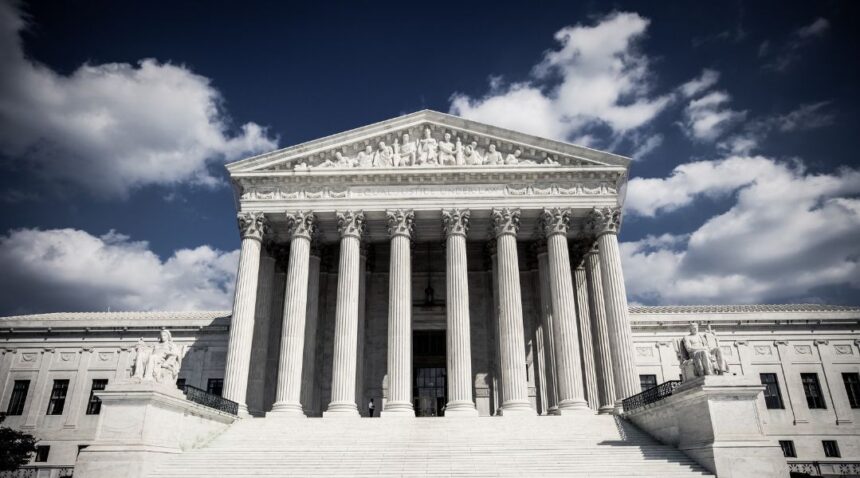
Justices Affirm Voting Rights Act Does Not Justify Use of Race in Drawing District Lines
WASHINGTON — The U.S. Supreme Court on Wednesday ruled 6-3 that a Louisiana congressional map creating a second majority-Black district amounted to unconstitutional racial gerrymandering, affirming a lower court decision that bars the state from using the map in future elections.
In Louisiana v. Callais, the justices held that the map—known as SB8—impermissibly prioritized race over traditional redistricting principles. Justice Samuel Alito, writing for the majority, concluded that because Section 2 of the Voting Rights Act of 1965 did not require Louisiana to draw an additional majority-minority district, the state lacked a compelling interest to justify sorting voters primarily by race.
The challenged map, enacted in 2024 following earlier litigation, increased the number of majority-Black congressional districts in Louisiana from one to two. Roughly one-third of the state’s population is Black. A group of voters identifying as “non-African American” sued, arguing the map violated the Equal Protection Clause of the Fourteenth Amendment by using race as the predominant factor in drawing district lines.
The Court’s conservative majority agreed, leaving in place the federal district court’s ruling against the map. The decision does not formally invalidate Section 2 of the Voting Rights Act, which prohibits voting practices that dilute minority voting strength. However, it significantly constrains how states may respond to potential Section 2 claims when drawing districts.
Justice Samuel Alito authored the majority opinion in Louisiana v. Callais, Justice Clarence Thomas filed a concurring opinion, joined by Justice Neil Gorsuch.
In a sharp dissent, Justice Elena Kagan—joined by Justices Sonia Sotomayor and Ketanji Brown Jackson—warned that the majority’s opinion effectively renders Section 2 “all but a dead letter.” Kagan argued the decision undermines Congress’s intent in the landmark civil rights law and retreats from prior precedents that allowed race-conscious remedies to prevent minority vote dilution.
Background of the Case
The dispute traces back to post-2020 census redistricting. Black voters and advocacy groups initially challenged Louisiana’s original map under Section 2 of the Voting Rights Act, arguing it packed Black voters into one district and cracked their influence across others, denying them an equal opportunity to elect preferred candidates.
In response, the Louisiana legislature passed SB8 in a special session, creating a second majority-Black district. That map was used in the 2024 elections. Shortly afterward, the “non-African American” plaintiffs filed suit, contending that race predominated over neutral criteria such as compactness, contiguity, and respect for political subdivisions.
A federal court agreed with the challengers, finding the map an unconstitutional racial gerrymander. Louisiana and intervening Black voters appealed, leading to Wednesday’s Supreme Court decision. The case was reargued in October 2025 after the justices directed additional briefing on the constitutional limits of race-based redistricting.
What It Means Going Forward
The ruling returns Louisiana to the drawing board for its six congressional districts ahead of the 2026 midterms. It is expected to boost Republican prospects in the state, as the invalidated second majority-Black district had been represented by a Democrat.
More broadly, the decision narrows the practical reach of Section 2 in redistricting cases nationwide. States facing VRA challenges will have less flexibility to create majority-minority districts without risking successful constitutional challenges from other voters. Legal observers note this could affect similar maps in other Southern and Southwestern states with sizable Black or Hispanic populations.
This case continues a line of Supreme Court decisions on redistricting and voting rights, building on precedents like Shaw v. Reno (1993), which first subjected overtly race-based districting to strict scrutiny. It also contrasts with the Court’s 2023 decision in the Alabama case Allen v. Milligan, which required a second majority-Black district in that state under the VRA.
Louisiana officials must now produce a new map that satisfies both constitutional requirements and any remaining obligations under federal voting rights law.