


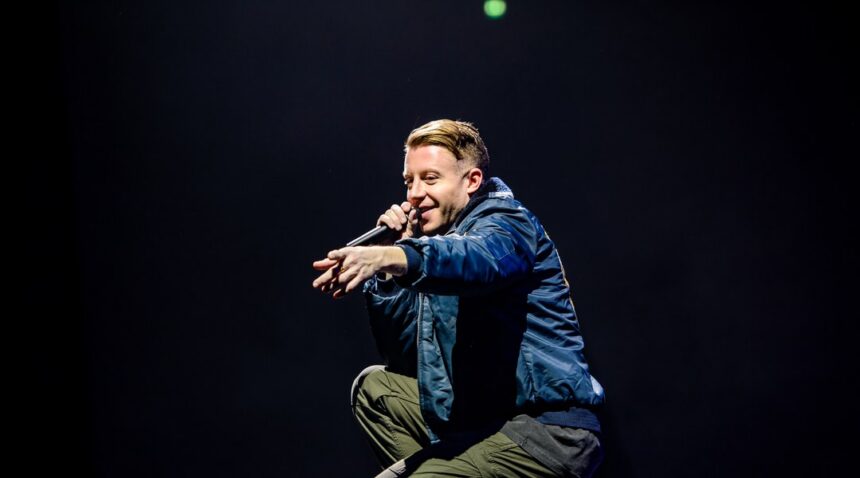
The rapper says stadium objections forced tour organizers to remove him, while venue representatives cite comments they consider antisemitic.
Rapper Macklemore has been removed from the remaining U.S. dates of Ed Sheeran’s Loop Tour following pro-Palestinian remarks he made during a September concert at MetLife Stadium.
Macklemore announced the decision on Instagram, saying multiple venues had told tour organizers they would not host shows if he remained on the lineup. Promoter Messina Touring Group confirmed that venue objections placed upcoming concerts at risk.
The rapper had been scheduled to appear at eight of Sheeran’s final 10 U.S. concerts.
Sheeran had not issued a public statement about the decision at the time of the announcement. Macklemore said the two musicians had held difficult conversations and that he did not harbor personal resentment toward Sheeran.
A Protest Song and a Stadium Dispute
During Sheeran’s September 5 MetLife Stadium show, Macklemore introduced “Hind’s Hall,” a protest song expressing solidarity with Palestinians, and called for a free Palestine.
He also told the audience that his criticism was directed at Israel’s government and military actions rather than Jewish people. Macklemore has repeatedly denied that his advocacy is antisemitic.
Critics have reached a different conclusion about portions of his rhetoric and public record. The Israeli-American Council had petitioned Sheeran to remove Macklemore from the tour, arguing that his appearances created an unsafe or hostile environment for Jewish concertgoers.
Robert Kraft, whose business interests include Gillette Stadium, said the decision involving that venue was based on Macklemore’s recent statements and what Kraft characterized as a broader history of antisemitic rhetoric. Kraft also acknowledged Palestinian suffering and offered to meet with the rapper.
Macklemore responded that criticism of Israel should not automatically be equated with hostility toward Jews. He said venue pressure—not a voluntary change in his advocacy—led to his removal.
Speech and Private Association
The dispute raises questions about expression, antisemitism, private contracts and the responsibilities of performers appearing before enormous audiences.
Macklemore retains the legal right to express political views. Private promoters, artists and venue operators also generally retain significant authority over whom they contract with and what risks they will accept at an event.
This was not a government ban or criminal penalty. It was a decision involving private venues, a touring artist and a promoter responding to controversy and possible cancellations.
That distinction does not resolve whether the venues acted wisely or whether every criticism of Macklemore is fair. It does clarify that free-speech protections do not guarantee a place on another artist’s privately organized tour.
Why This Matters
The Israel-Gaza conflict has intensified debates over where criticism of Israeli policy ends and antisemitism begins. Sweeping accusations can silence legitimate discussion, while careless language can expose Jewish people to collective blame for decisions they did not make.
Concern for Palestinian civilians and opposition to antisemitism are not mutually exclusive. Public figures bear a responsibility to communicate both convictions with accuracy and moral clarity.
The parties should be represented according to what they have actually said: Macklemore denies hostility toward Jews, while objecting venues say their concerns extend beyond criticism of Israeli policy. Those competing claims should not be collapsed into a slogan.
THRIVE! Perspective
James 1:19 urges people to be quick to listen and slow to speak. Proverbs 18:21 warns that words carry the power of life and death.
Scripture condemns hatred and requires Christians to tell the truth about both suffering and wrongdoing. That means rejecting antisemitism, recognizing the dignity of Palestinian civilians and refusing to treat an entire people as responsible for the acts of governments or armed groups.
Public influence brings accountability. So does the authority to close a platform. Every participant should use that influence truthfully, consistently and with care for the people affected.