



How Revolutionary Ideas, Ideological Conformity, and Historical Amnesia Fuel Political Violence
Every political movement has its fringe. Every era has its radicals. The real question isn’t whether extremists exist. It’s whether respectable people find ways to excuse them.
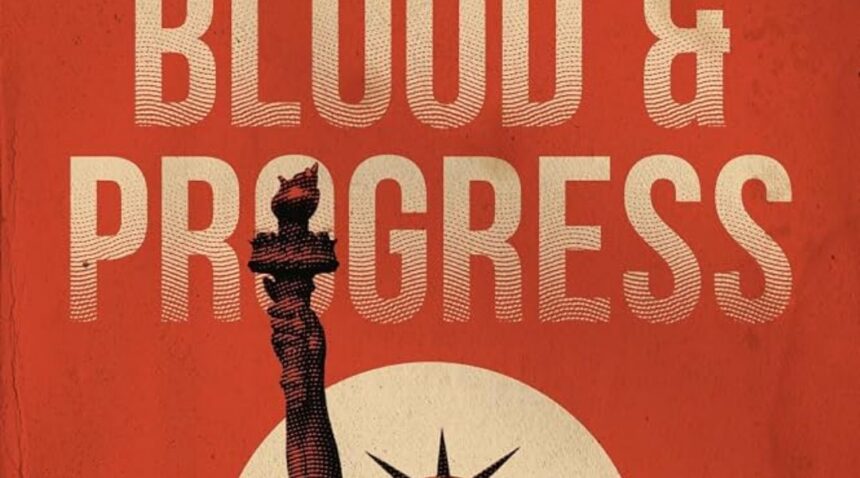
That is the unsettling question running through Noah Rothman’s outstanding new book, Blood and Progress: A Century of Left-Wing Violence in America. It’s also what made his recent appearance on A.J. Rice’s Dangerous Laughter one of the podcast’s most substantive conversations to date.
In an age when podcasts often devolve into performative outrage or partisan food fights, Rice took a different approach. Known for blending satire with politics, the host largely stepped aside and allowed Rothman to unpack the historical ideas that have repeatedly transformed political frustration into political violence. The result wasn’t merely an interview promoting a new book. It was a thoughtful discussion about how dangerous ideas survive long after the headlines fade.
Rothman’s central argument deserves a wide audience because it challenges a comforting myth.
Political violence rarely appears out of nowhere.
Long before someone throws a bomb, assassinates a political opponent, torches a business, or cheers an act of terror, there is almost always a cultural process that makes such behavior seem understandable—even admirable—to a small but vocal segment of society.
Ideas prepare the ground. Violence merely follows.
Throughout Blood and Progress, Rothman traces more than a century of revolutionary thought, from early twentieth-century radicals to today’s activists, demonstrating that while the slogans evolve, the underlying justification remains remarkably familiar. Violence is portrayed as regrettable but necessary. Institutions are declared irredeemably corrupt. Revolution becomes morally cleansing rather than morally compromising.
As Rothman explained during the conversation with Rice, revolutionary movements often convince themselves that one spectacular act of bloodshed will awaken the public and spark sweeping political transformation. History shows otherwise, but the fantasy persists because every generation imagines it will succeed where the last one failed.
One of the interview’s most compelling moments came during a discussion of what Rothman calls the “permission structure” surrounding violence. Contrary to popular belief, widespread support isn’t necessary.
If only a small percentage of the population embraces political violence while everyone else hesitates to condemn it, whether out of fear, tribal loyalty, or ideological convenience, the normalization process begins. Silence becomes accommodation. Accommodation becomes acceptance. Acceptance becomes encouragement.
That insight gives Blood and Progress much of its urgency. The book is not an argument that America is destined to descend into widespread political violence. Rather, it is a warning that societies drift toward extremism when they become selective about whose violence deserves condemnation.
Rothman is equally persuasive when examining anti-Israel activism after October 7. During the interview, he argues that many contemporary narratives are not new at all but echoes of Soviet propaganda designed decades ago to delegitimize Israel. Those talking points survived the Cold War because they proved politically useful, and they continue resurfacing whenever terrorism is reframed as “resistance” rather than barbarism.
Rice deserves credit for resisting the temptation to reduce the conversation to today’s news cycle. Instead, he continually steers the discussion back toward first principles: the role of ideas, the corrosive effects of ideological purity tests, and the historical relationship between utopian thinking and political coercion.
His observation that modern politics increasingly resembles a new Puritanism, with ever-shifting standards of ideological purity, provides an effective bridge into Rothman’s broader historical analysis.
That willingness to mix history, culture, humor, and politics has become the defining characteristic of Dangerous Laughter. Rice’s style is unmistakably irreverent, but beneath the jokes is an instinct that many political commentators overlook: culture almost always precedes politics.
Ideas spread long before legislation. Narratives shape movements long before elections.
Books matter because they teach people how to think before politicians tell them what to think. That’s ultimately why Blood and Progress stands out.
It is not a catalog of violent episodes, nor is it a partisan scorecard. It is an examination of recurring intellectual habits that repeatedly convince otherwise ordinary people that extraordinary acts are morally justified. Rothman reminds readers that violent movements rarely begin by celebrating bloodshed. They begin by redefining it.
In today’s polarized environment, that’s a lesson Americans of every political persuasion would do well to remember.
Good interviews leave you wanting to read the book. Great books leave you looking differently at the world around you.
This episode of Dangerous Laughter accomplishes the first. Noah Rothman’s Blood and Progress accomplishes the second.
Julio Rivera is a business and political strategist, cybersecurity researcher, founder of ItFunk.org and ReactionaryTimes.com, and a political commentator and columnist. His writing, focused on cybersecurity and politics, has appeared in major publications around the world.