



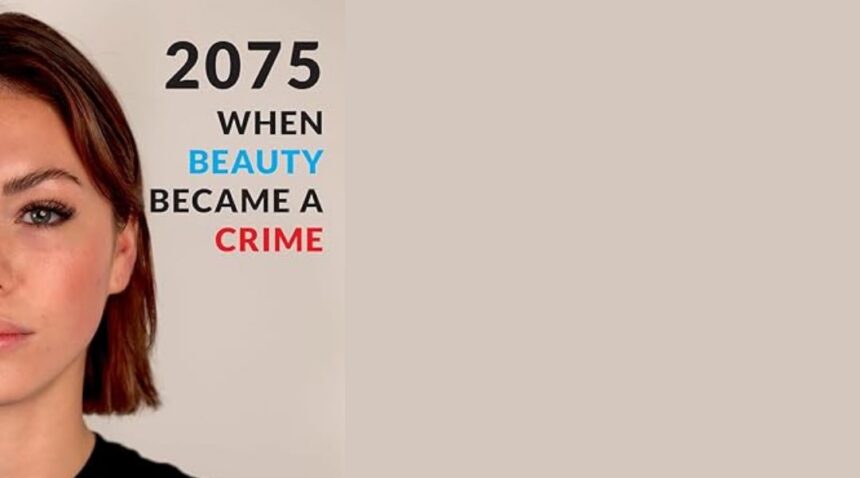
The Future of Cancel Culture? New Novel Set In 2075 Imagines A World Where Beauty Is a Crime
The setting is 50 years in the future when social media has promoted ideas of social justice that implies some people enjoy privileges that they were born with, giving them “unfair” advantages in life. When one says “they are born with privilege,” it is implied that they did nothing to advance their own condition. Life was merely a genetic roll of the dice that favored the conditions of some, undeservedly, compared to all others in society.
These skewed advantages from the perceptions of physical beauty arise in all aspects of life by the treatment of others in support of success in careers, romance, friendships, politics, and all aspects of commercial and social acceptance. Those who aren’t specimens of great physical beauty are doomed to suffer the shortcomings and obstacles in life. The crime, therefore, is two-fold: 1) those who are perceived beautiful and 2) those who perceive others as ugly. These distinctions must be erased.
An abundance of research is cited from fictional future studies, often reflecting actual research of recent history in the U.S. and Europe, to substantiate the claim of superior status based on perceptions of beauty. Such status is referred to as “PB” or “Privileged Beauty” that sets people apart, regardless of personal achievement. Alongside this status it is argued that much of the commercial world caters to these prejudices with merchandise that augments privileged characteristics of appearance.
Advanced AI mechanisms in the story have been assigned to evaluate the entire populace by a measure of beauty characteristics and all people can then be ranked on an appearance scale from 1 to 100, with the top 10% becoming the prime targets as PB. Once PB’s are identified, the advocates of social justice, the Movement for Optical Justice (MOJ or MOVE) demand a revolutionary change in attitudes of societal pressure, shaming, and eventually legally imposed statutes to rectify the presumed injustice to society by the existence of PB’s.
At the culmination of the political power of MOVE, the law mandates that any female PB, with a score of 90% or above and reaching the age of 15 must undergo surgery to lower her PB score. Dr. Zitelmann brilliantly presents the range of arguments that emerge, from exempting males from the scalpel to using the scalpel to improve the PB score of the “ugly.” The MOVE ferociously reacts to the mere notion of “ugly” as a societal prejudice, as cruel as “racism,” that must be eradicated in order to bring about true equality.
Into this context the protagonist is presented as Alexa, clearly identified as a very attractive PB, who is pleased with her appearance but at times struggles with a measure of guilt in the midst of a pervasive flood of condemnation because of her presumed, unearned advantages in life. (Interesting that Dr. Zitelmann chooses the name of Alexa, also the voice of the popular Amazon AI Assistant so familiar to millions of households.)
Alexa is a complex individual who has encountered the multitude of human responses from her contemporaries, sometimes even negative to her standout beauty and always complicated by the variety of personality factors of others around her. Dr. Zitelmann has Alexa weaving through players on all sides of the issue, demonstrating the extent that contemporary 2025 wokisms about “white privilege” and “racism” have focused on the future of PB.
Coincident with this novel, Dr. Zitelmann, authored a non-fiction work, New Space Capitalism, that shares a well-researched anticipation for space travel and advances in technology in the near future. It is surely tough to gauge a time frame for the vision of his novel. My feeling while reading the book, which I thoroughly enjoyed and read through without stopping, was that 50 years was much too far in the future for what he describes.
The panic and responses of social justice warriors seems so relevant today that one could probably expect an attack on PB within a much shorter time. Also, with AI self-learning at an exponential rate, with the cost and efficiency of space travel rapidly improving, and with the soaring rise in demand for rare interplanetary resources, I would expect this scenario to arrive much sooner.
2075 When Beauty Became a Crime opens with the worst of possible outcomes dissected and explained as the rational evolution of social justice movements that exist today and the fawning collaboration of politicians in catering to these popular impulses of resentment and envy. The real beauty of this book is in the emergence of a positively contagious courage, of proud and powerful individuality reasserted. It isn’t just bluster. It is a fiercely intellectual scrutiny of the hypocrisies that abound in the social justice milieu.
What finally emerges through Dr. Zitelmann’s extraordinary vision of the future is an examination of true character. He reminds me of a lesson from my grandfather, a scholar of the classics: Greek, Latin, Hebrew, German, French, English, and Dutch. “Character,” he told me, “is from the root ‘to scratch,’ as if carving into a smooth marble stone. The beauty of the sculptor’s statute doesn’t come from the raw marble. It emerges by the individual marks. Without the scratches in life, one is left without character.” Alexa discovers the real, intimate beauty of her character.
Ken Schoolland is Professor of Economics Emeritus at Hawaii Pacific University