

Pastor Lian Xuliang has returned to his family, but the legal status of his father, a fellow church worker and their unregistered congregation remains unclear.
A Chinese house-church pastor has returned home after more than four years of detention, surveillance and unresolved legal proceedings connected to his unregistered congregation.
Pastor Lian Xuliang of the Xi’an Church of Abundance returned to his family September 5, according to ChinaAid, which cited the Chinese human-rights monitoring organization Weiquanwang.
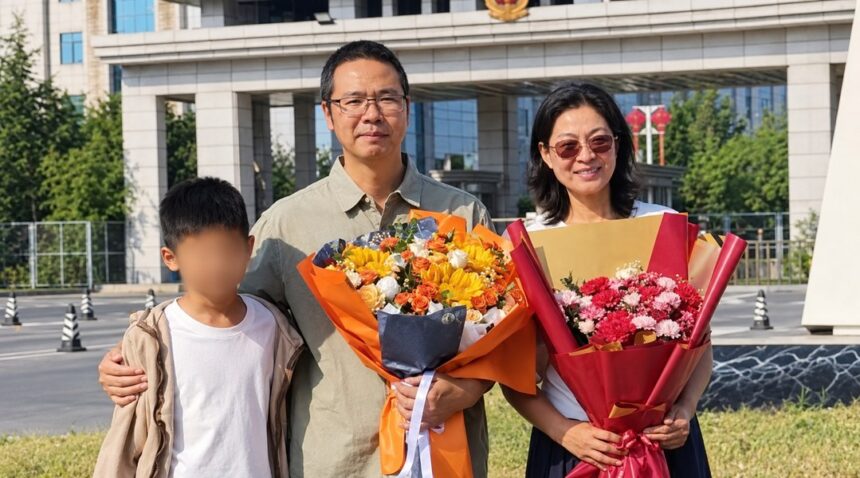
Photographs published by ChinaAid show Lian with members of his family following his release. Chinese authorities have not publicly explained why he was released or whether the criminal case against him remains active.
The status of his father, Pastor Lian Changnian, and church worker Fu Juan also remains unclear.
A Four-Year Case Against Church Leaders
Police placed the three Christians under residential surveillance at a designated location on August 17, 2022. This form of secret detention can allow authorities to hold suspects away from ordinary detention centers with limited access to families or attorneys.
Officials accused the church leaders of fraud in connection with their ministry and church offerings. Rights advocates contend that fraud and other economic charges have increasingly been used against leaders of churches that decline to join China’s state-controlled religious system.
Two days after the detentions, the Xi’an Municipal Civil Affairs Bureau banned the Church of Abundance. Authorities said it had operated as an unauthorized social organization because it was not registered with the government.
Lian, his father and Fu were formally arrested in March 2023. They were released under compulsory measures in April 2025 and tried July 9, 2025, but the court did not publicly issue a verdict.
Authorities detained all three again that November while they awaited a decision.
Reports of Torture and Mistreatment
ChinaAid and other religious-freedom monitors say the defendants experienced varying degrees of torture or mistreatment during secret detention.
Earlier reports described alleged beatings, food deprivation, forced medication and denial of bathroom access. These accounts come from relatives, attorneys and advocacy organizations; Chinese authorities have not publicly addressed the specific allegations.
The U.S. Commission on International Religious Freedom has also maintained a case record for Lian, identifying his religious activity and participation in an unregistered church as reasons for his detention. Its online status entry had not yet been updated to reflect the newly reported release when checked.
Lian’s return home is therefore significant good news, but it does not resolve the broader case. There has been no public explanation of his legal status, the position of the other two defendants or whether the Church of Abundance will be permitted to resume gathering.
China’s Pressure on House Churches
China permits worship through religious bodies controlled and monitored by the government. Many Protestant Christians instead gather in independent house churches because they believe state registration would compromise the Church’s doctrine, leadership or mission.
Those congregations may face raids, surveillance, property seizures, pressure on landlords, restrictions involving children and criminal charges against pastors.
The circumstances vary by province and congregation, but the Church of Abundance case reflects a continuing conflict between state control and Christians who believe the Church must ultimately obey Christ.
Why This Matters
Religious liberty includes more than permission to hold private beliefs. It protects the ability to gather, teach, pray, select leaders and carry out peaceful ministry without government coercion.
Lian’s release deserves gratitude, but attention should remain on his father, Fu Juan and other Christians whose status is unresolved. Advocacy is most useful when it preserves those distinctions rather than treating one release as proof that the underlying pressure has ended.
THRIVE! Perspective
Hebrews 13:3 tells Christians to remember prisoners as though imprisoned with them. Second Timothy 2:9 declares that although God’s servants may be bound, the Word of God is not bound.
Christians should thank God that Lian has returned to his family and continue praying for physical, emotional and spiritual healing. They should also pray for the other defendants, their congregation and Chinese officials.
The Church’s allegiance to Jesus Christ does not depend on state recognition. Governments should protect peaceful worship, while believers remain called to faithful witness even when authorities impose a cost.