

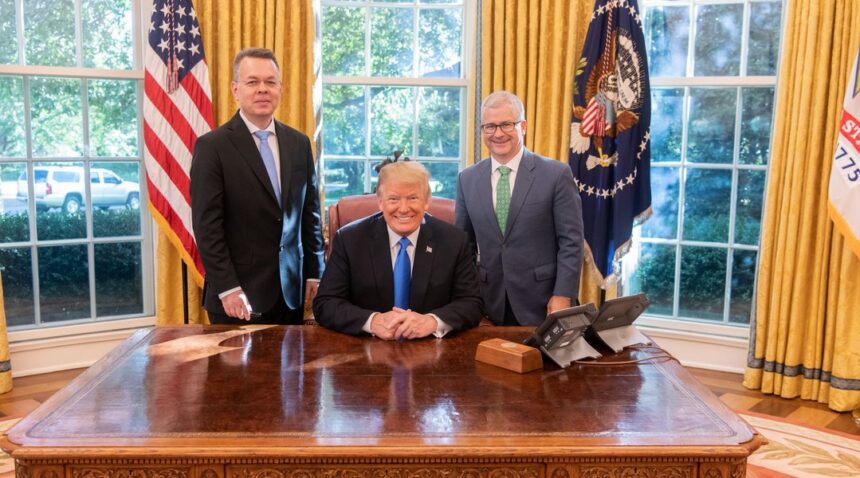
The appointments bring a former imprisoned missionary, a Catholic bishop and a former White House adviser to the bipartisan federal watchdog.
President Trump has appointed Andrew Brunson, Bishop Robert Barron and Joe Grogan to the U.S. Commission on International Religious Freedom, restoring the agency’s full bipartisan membership.
The commission announced the appointments September 16. USCIRF monitors religious persecution abroad and recommends responses to the president, secretary of state and Congress.
The appointments are separate from President Trump’s nomination of Cissie Graham Lynch to become ambassador at large for international religious freedom. That State Department position requires Senate confirmation. USCIRF commissioners are appointed directly under the commission’s governing framework. USCIRF announcement.
A Missionary Who Experienced Imprisonment
Brunson brings personal experience of detention overseas.
The American pastor spent 23 years as a missionary in Turkey before his arrest in 2016. He remained detained for two years and was released in 2018 following diplomatic pressure.
He later wrote the memoir God’s Hostage and leads WaveStarters, a ministry focused on persecuted Christians, according to USCIRF’s biographical announcement.
His appointment places someone who experienced prolonged separation from family and congregation inside a body charged with examining religious-freedom abuses.
Experience in Ministry and Public Policy
Barron serves as bishop of the Catholic Diocese of Winona-Rochester, Minnesota, and founded Word on Fire Catholic Ministries. He is also known for the documentary series Catholicism.
He previously served on the administration’s domestic Religious Liberty Commission. His new appointment concerns religious freedom internationally.
Barron said he was honored to accept the role and emphasized the commission’s bipartisan character, OSV News reported.
Grogan served as director of the White House Domestic Policy Council during President Trump’s first term. His background includes healthcare and public policy, and he is a visiting senior scholar at the University of Southern California’s Schaeffer Institute.
What USCIRF Does
Congress created USCIRF through the International Religious Freedom Act of 1998. It operates as an independent agency within the legislative branch.
Its nine commissioners are selected through appointments divided among the president and congressional leaders. Its work concerns freedom of religion or belief for people of every faith and for those who hold no religious belief.
The commission studies conditions abroad, documents violations and recommends policy. Its findings can inform American diplomacy, but the commission does not itself conduct prosecutions or operate as a missionary organization. USCIRF’s explanation of its responsibilities.
If confirmed as ambassador, Lynch would lead the State Department’s international religious-freedom office and serve as an ex-officio commission member. THRIVE! previously reported on her nomination.
Why This Matters
Religious-freedom reporting can bring attention to prisoners, congregations and minority communities whose experiences might otherwise receive little international scrutiny.
The new appointments fill vacancies and give the commission its required membership. Their significance will become clearer through the commissioners’ investigations, recommendations and attention to individual cases.
For American readers, the distinction between the commission and the ambassador’s office helps clarify who documents abuses, who recommends policy and who directs diplomatic engagement.
THRIVE! Perspective
Hebrews 13:3 calls Christians to remember prisoners with an identification that reaches beyond distant sympathy. Brunson’s experience makes that responsibility particularly tangible.
First Timothy 2:1–2 also calls believers to pray for those in authority. Wisdom, integrity and concern for vulnerable people are fitting prayers for every commissioner.
Government can work to protect religious liberty. The Church’s calling remains its own: proclaim Jesus Christ, make disciples, support suffering believers and serve neighbors faithfully. Appointments may create opportunities for advocacy, but they do not replace that continuing responsibility.